At the invitation of Prof. Dong Guanghui from the School of Earth and Environmental Sciences, Lanzhou University, and Key Laboratory of Western China's Environmental Systems, Ministry of Education, China, Prof. Artur Kharinskii from Irkutsk National Research Technical University, Russia, visited our university for academic exchange from January 7 to 15, 2026. During his stay, he delivered two academic lectures in Room 502, Qilian Hall, Chengguan Campus.
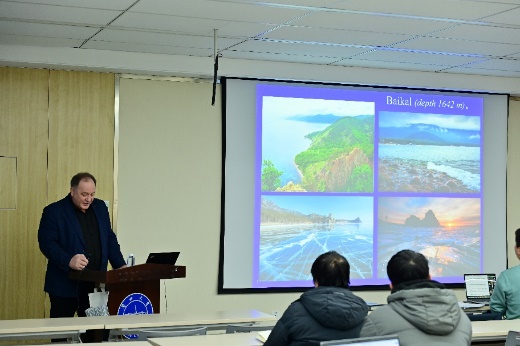

On January 8, Professor Artur Kharinskii presented a lecture titled "The Emergence and Development of Pastoralism in the Baikal Region (Late 2nd Millennium BC–Early 1st Millennium AD)". Through a systematic review of multiple archaeological cultures in the Baikal region, Professor Kharinskii clarified the origin and developmental trajectory of pastoralism in the area. In Mongolia and Siberia, the earliest remains of domesticated ungulates were found in sites of the Afanasievo Culture (3300–2500 BC), providing crucial evidence for the emergence of pastoralism. The Ulaanzuuh-Tavsh Culture (1450–1000 BC) facilitated the spread of pastoralism in eastern Mongolia, laying the foundation for its development in the southern Transbaikal region. By the end of the 2nd millennium BC, the Slab Grave Culture had widely diffused across the forest-steppe zones of the Baikal region, making pastoral economy the dominant economic type and marking the maturation of ancient nomadic civilizations.
On January 9, Professor Artur Kharinskii delivered another lecture titled "The Formation of the Northern Periphery of the Mongol Empire: Nomadic Pastoralists and the Surrounding Landscape". As a polity rising in the 13th century, the Mongol Empire encompassed vast territories and exerted profound influence on the political landscape, cultural exchanges, and population movements across Eurasia. Through archaeological remains such as tombs and pottery, Professor Kharinskii illustrated the cultural influence exerted by the Mongol Empire on surrounding regions. By cross-referencing archaeological evidence with historical documents, he outlined a comprehensive narrative of the empire's origin, expansion, and cultural integration, offering significant insights for research on ancient nomadic civilizations in Eurasia.
Following the lectures, faculty and students engaged in lively discussions on the topics presented, fostering productive academic interaction and intellectual exchange between the fields of geography and archaeology. During his visit, Professor Artur Kharinskii also toured the Testing Center of the Key Laboratory of Western China's Environmental Systems (Ministry of Education) at Lanzhou University. He held in-depth discussions with Professor Dong Guanghui's research team on their respective research areas, laying a solid foundation for further international collaboration.


